The VHS Files: Teaching Machines the Poetry of Steak in Cronenberg's The Fly

In the ‘80s, there was a boom in remakes of great horror movies from the ‘40 and ‘50s (most of these pretty campy, and definitely unscary):
The Thing, The Blob, and The Fly all have stood the test of time and are regarded as classics today. (Invaders from Mars and Cat People, not so much.) In fact, many of today’s viewers aren’t aware that these are remakes, so solid are the “newer” versions.
David Cronenberg's The Fly (1986) is a particularly smart (and deeply horrifying) recast of a pretty goofy idea: what if a man and a fly switched places/heads as the result of a Science Experiment Gone Awry? My mom used to speak fondly of seeing the Vincent Price Fly in the movie theatre, with its iconic (and admittedly creepy) “HELP MEEEEEE” climactic scene. (On a side note, she also told me often about being freaked out by The Tingler, which seems like it should have also had an ‘80s remake treatment, given the possibilities of special makeup effects at the time, and how cheesy the original carrion-crawler-like rubber critter was.)

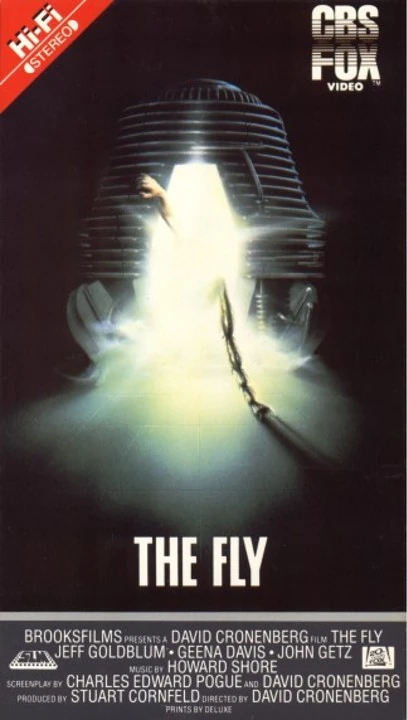
The Fly treads the path laid down by Mary Shelley, with physicist Seth Brundle developing a means of teleportation in his home laboratory, only to use the power he’s discovered on himself (in a state of drunken, jealous hubris), accidentally merging his DNA with that of a fly that was trapped in the teleporter with him. Like Victor Frankenstein, he has Meddled with Forces He Does Not Fully Understand, and his mistake becomes fatal as the gentle, awkward scientist fades and the insect within him (revoltingly) awakens.
Many have written at length about the disease allegory body horror of Cronenberg’s remake; after all, 1986 was the peak of the AIDS epidemic, and in 1980, NIH had released its first report on carcinogens, revealing the many ways that humanity had unwittingly exposed itself to the disease.
More recently, writers like Tori Potenza have examined the sexual politics of the film, analyzing the role of the male characters’ insecurity in the horror faced by the female lead, Genna Davis’s Veronica. Because she is the crux of a love triangle between the inexperienced and awkward genius Seth and the arrogant and jealous former lover/boss Stathis, Veronica is almost literally torn between them by the end of the film.
Instead of recycling these fascinating interpretations of The Fly, I’d like to remember and unpack one brief scene in the “romantic comedy” part of the film which shows Seth and Veronica at home in the lab, having just consummated their new relationship (and performed a failed test of the teleporters that results in a baboon being turned inside out). This scene, I think, has something to show us about our current relationship with computers. When we seek to go beyond the mystery and wonder of the body—like the current “transhuman” obsession of the tech-bro overlords—we are Meddling With Forces We Don’t Fully Understand, to our collective detriment.
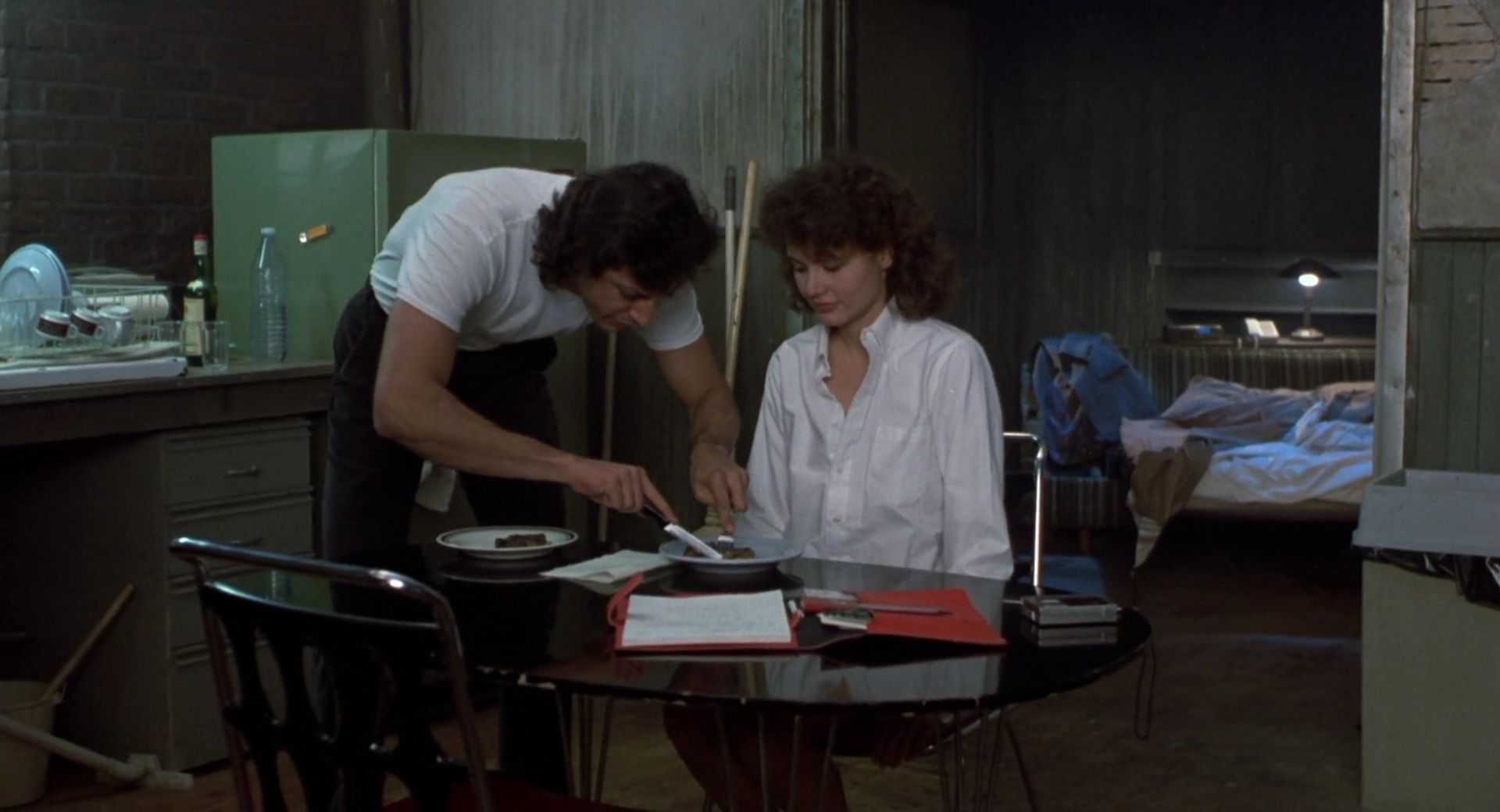
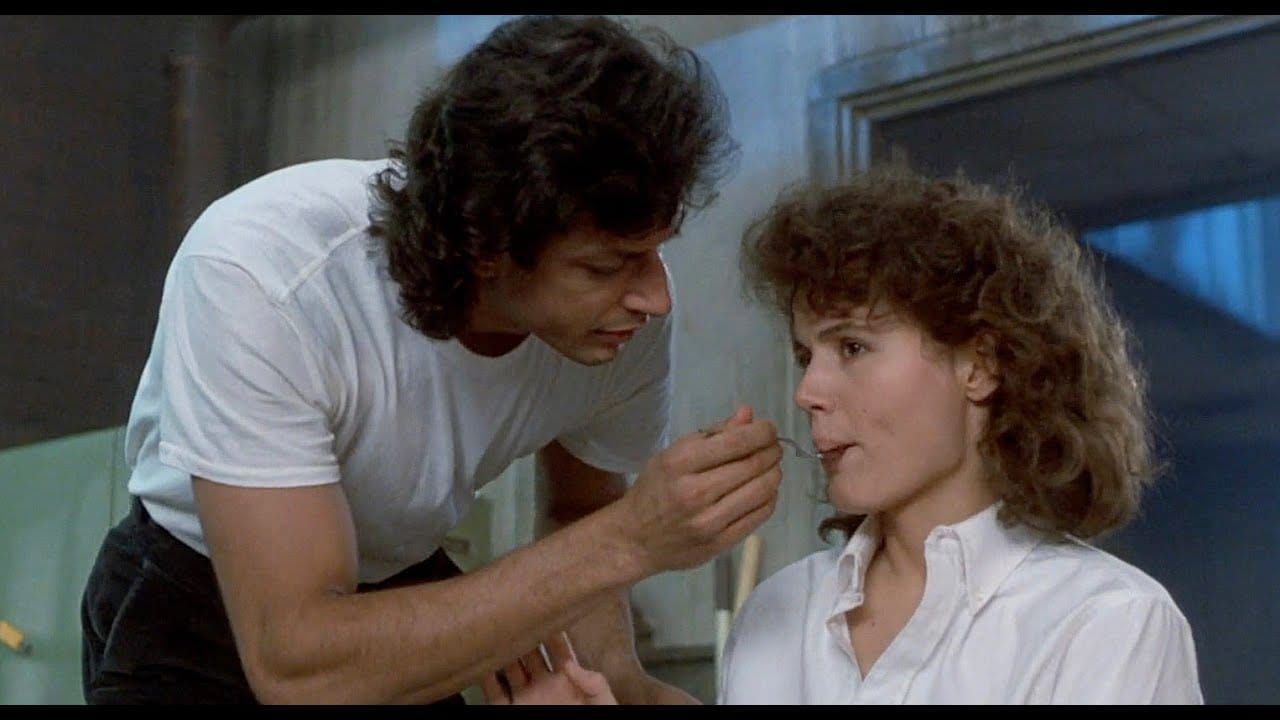
The scene starts with a bit of charming pillow talk. Post love-making, Veronica jokingly bites Seth on the arm saying “sorry, I just want to eat you up. That’s why old ladies pinch babies’ cheeks. It’s the flesh. It just makes you crazy.” This innocent line sparks an insight for Seth, who leaps out of bed, envisioning an experiment with the telepods.
He cuts one of the steaks that Veronica brought for dinner in half, and sends one half through the teleportation sequence, then cooks both halves.
After trying the teleported piece, Veronica spits it out, saying, “Oh, it tastes funny…It tastes…synthetic.”
I think of this line every time I read yet another LLM-generated “essay” by one of my students. Machine-made text reads “funny.” It’s produced by a program that is inherently ignorant of the experience of taste, the nuances of flavor, the “finesse” (as Veronica aptly suggests) of cuisine. Think about the difference between eating for subsistence and eating for pleasure; one can certainly be quantified and made into an algorithm, but the other—the other is part of the delightful experience of flesh-and-blood humanity.
This is Seth’s eureka moment. “The computer is giving us its interpretation of a steak. It’s, uh, translating it for us. It’s rethinking it rather than reproducing it and something’s getting lost in the translation…the flesh. It should be making the computer crazy, like those old ladies pinching babies. But not yet, I haven’t taught the computer how to be made crazy by the…flesh. The poetry of the steak.”
Sure, “the poetry of the steak” is comic-book science, and we never actually see what Seth means by teaching the computer to be “made crazy.” But this bit of dialogue reveals the film’s warning about machine learning: that there are some aspects of the embodied experience that cannot be captured as data, that are illogical, unquantifiable, “crazy.” A machine will never really understand what makes an old lady “pinch” a baby, an act antithetical to the rational role of adult humans in child-rearing.
More importantly, to my mind, the machine can be trained on every poem ever published from the web (scraped without regard to intellectual property, I might add), but it can never understand how it feels for the reader to experience the figure a poem makes. The poetry of the steak will always already exist, but only through reading and thinking and remembering by a human being who exists bodily in time and space will that poetry ever have meaning. This is the center of my own practice as a teacher of poetry; the vocabulary, technique and form of a poem, its “data,” mean nothing without a reader who has also grown up, had dreams, experienced heartbreak and confusion, fallen in love, looked up at the stars, or, indeed, eaten a delicious steak. (Or fish or tofu or whatever.)
Earlier in the film, in a frustrated outburst, Seth mutters, “Computers are dumb. They only know what you tell them. I must not know enough about the flesh myself.” As we, today, continue to dump unfathomable resources into data center and LLM development, even the designers and programmers don’t themselves know what they have “told” the machines, and cannot account for their resultant behavior. No one really knows how LLMs work, and yet, Amazon is already touting its AI health app, saying it’ll be your “best friend” in helping you understand your own body and when to seek human medical attention.
Smarter/better/faster/More Everything Forever thinking sounds great. Who wouldn’t want to live in a world where mysteries are explained, pain is ameliorated, and the body is no longer “crazy?”
Upon sending himself through the machine, but before the fly DNA begins to mutate him, Seth is ecstatic. He misreads his newfound insect-strength as the result of digital sanctification. “It’s like coffee being put through a filter. It’s somehow purified me. It’s cleansed me. Not to wax messianic….what an accomplishment! But what have I really done? All I've said to the world is, ‘let’s go! Move! Catch me if you can!’”
Veronica sees the trouble, though, in her as-yet-human perspective. Seth’s loss of control begins with his appetites (“Do you normally take coffee with your sugar?”) and increasingly unhinged ranting. “Molecular decimation, breakdown, and reformation is inherently purifying. It makes a man feel like a king.” The process Seth doesn’t fully understand has led him (“however subjectively”) to believe in his own power.
As for “waxing messianic,” is there any better phrase to describe the current behavior of the Tech-bro priesthood? Conquering space? Conquering the brain? Conquering death?
Initially, Seth feels his genetic corruption as integrity, that the computer has made him feel that he is more than he could be on his own. “It’s like a drug, but a perfectly pure and benign drug. The power I feel surging inside me!” Of course, there is no such thing as a “perfectly benign drug.” All alteration from nature comes at a cost. Seth has gone “crazy” about his own flesh, misinterpreting the initial results; Veronica knows he is “sick,” but he refuses to contemplate for a moment that he is wrong–throwing her out of his lab and his life. “You're afraid to dive into the plasma pool, aren't you? You're afraid to be destroyed and recreated, aren't you? I'll bet you think that you woke me up about the flesh, don't you? But you only know society's straight line about the flesh. You can't penetrate beyond society's sick, gray, fear of the flesh. Drink deep, or taste not, the plasma spring! Y'see what I'm saying? And I'm not just talking about sex and penetration. I'm talking about penetration beyond the veil of the flesh! A deep penetrating dive into the plasma pool!”
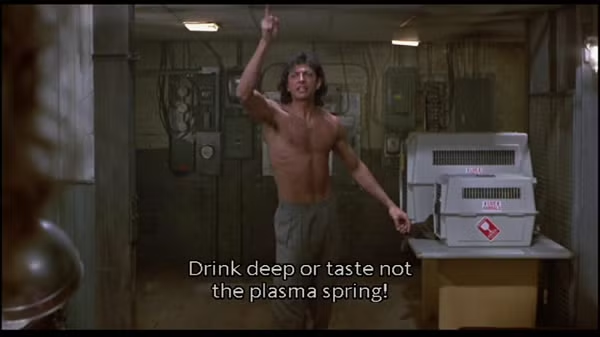
Seth’s reference to Pope’s Essay on Criticism (“drink deep or taste not the Pierian spring”) couldn’t be more ironic: he skips Pope’s preceding line, “A little learning is a dangerous thing.” Sure, he has been working on his telepods for six years (we find out early on) but his own self-experimentation is as “little learning” as even a shoddy scientist could base a conclusion on. His male rage, his sexual insecurity, his inexperience, perhaps even his neuroatypical mind, have all come to a head here, and thus begins Seth’s descent into disease and madness.
This being a Cronenberg movie, the body horror is inevitably tied to sex and sexuality. Seth has indeed penetrated “beyond the veil of the flesh,” but he has not escaped it altogether. As his body degrades into a being he jokingly names “Brundlefly,” Veronica desperately tries to “help him be human.” But Brundlefly, the “brutal” creature, decides that his ultimate technological solution will be to merge his body with the bodies of Veronica and their unborn baby (“more human than I am alone”) using the third prototype telepod he has gathering dust in the corner of the lab.
Stathis shows up with an elephant gun (a symbol of white-dude bourgeois phallic anxiety if there ever was one), which, after being brutally disfigured by an almost joyful Brundlefly, he manages to use to disconnect the pods at the last moment. The “dumb” computer once again becomes “confused,” and splices together man, fly, and telepod, resulting in a gory lump of flesh fused with wires, conduits, and the signature fins of the machine.
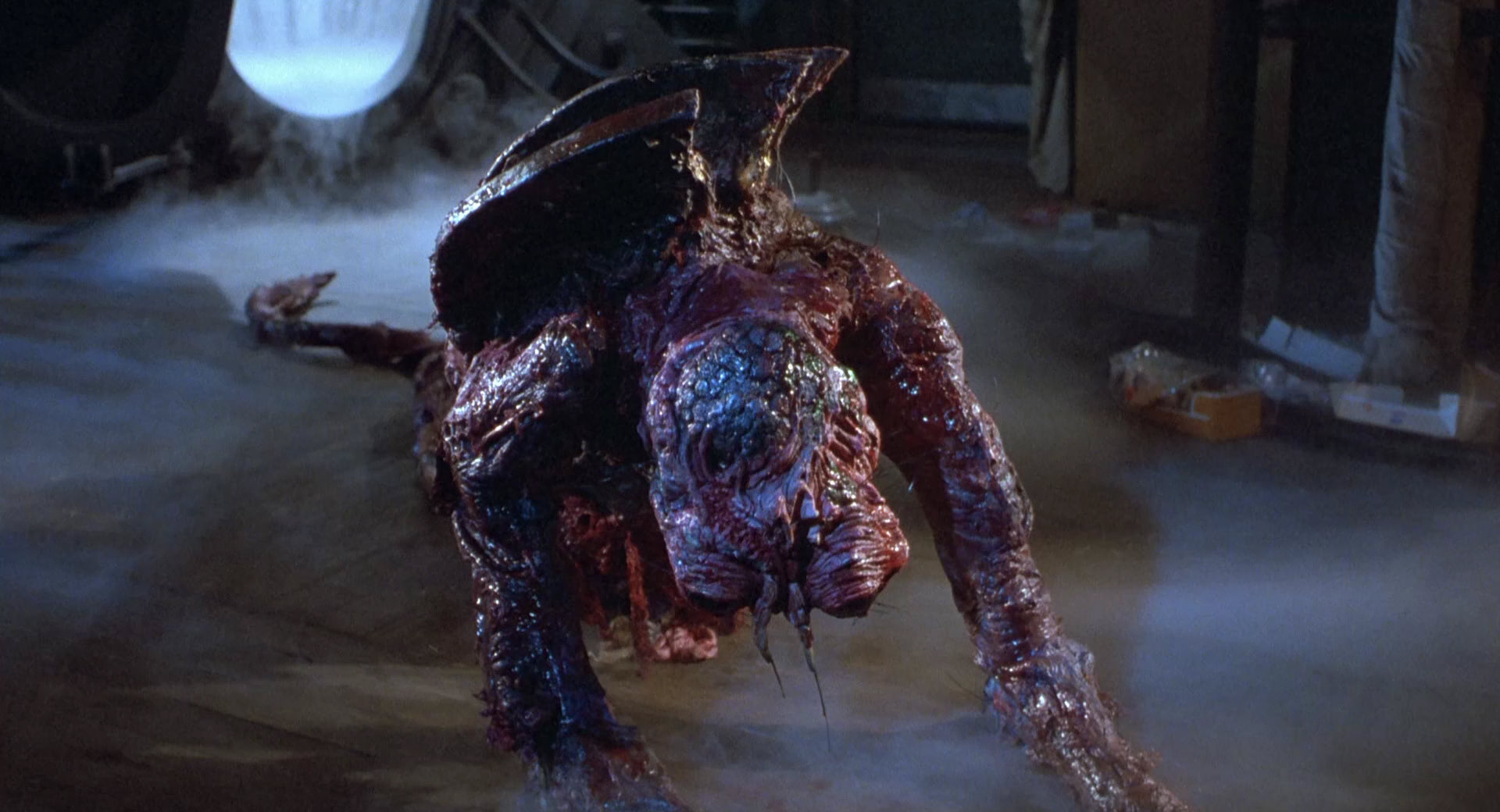
This “transhuman” being can no longer bear the pain of its existence. In the final, devastating scene, it points the barrel of the gun at its head, wordlessly begging Veronica to end it, which she can barely manage. The film fades to black with only the sound of Veronica’s sobbing in the aftermath, lost in the darkness and distance.
Science fiction and horror are rarely subtle, and no one has ever accused Cronenberg of subtlety. But the warning here isn’t maybe the first thing you think of when you reflect on this excellent and deeply disturbing film. Beyond the gore and utter horror, there’s a prescient omen of today’s technological “move fast, break things” ethos, where “disruption” is seen as a virtuous quest undertaken by lone genius Davids among the Goliaths of established markets, rather than a destabilizing and disorienting fragmentation of the social order that the word market represents. Seth’s telepods are Uber, Tesla, Amazon, Doordash, Twitter; they’ll change transportation as we know it. But the way that Seth tries to break everything, his moment of truth, when he himself is broken down and reassembled by the “dumb” machine, reveals a fundamental problem with breaking things just to see what happens (and how one can profit). As the practice of training the mind as part of a body in school becomes disrupted by the telepods of AI and LLMS, we risk becoming the wordless, blind, helpless chimerae of flesh and machine.
As a teacher, I struggle more and more to find ways to help my students experience the bodily thrill of understanding that can come from reading—the emotional peaks that poetry (or novels, or films) can elicit in a reader. I have felt that thrill so many times myself, but I have decades of practice. When they outsource the experience, asking the machine to explain to them what a poem means, and then present that outsourced output as their own thinking, they’re rejecting their own bodily experiences. They won’t be made crazy by the flesh, and that is truly scary.